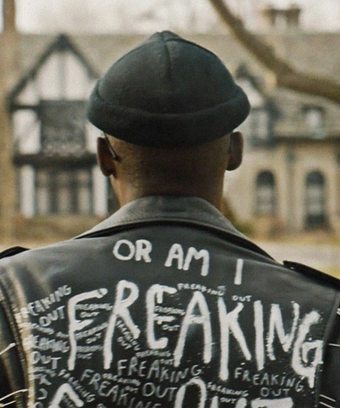
Now, I’ll start by saying that this is about Native Son, so if you haven’t read it this won’t make too much sense…
…Anyway! As I was reading Native Son, reading all the horrific descriptions of Bigger, a young black teen living in Chicago, unapologetically murdering an innocent girl that was being incredibly nice to him, pulling a knife on and more or less torturing one of his only friends, almost not taking a well paying job even though his family would starve if he didn’t take it, murdering “his girl” with a brick while she was sleeping, one question stuck with me. Why Bigger?
Why would Richard Wright, himself being a black man who wrote the book to highlight racial issues and injustices facing America at the time, choose the main character to be the very embodiment of evil, a boy of twisted virtue that many racists at the time claimed is prevalent in much of the black population? Why would he not choose to write the main character as a virtuous, kind person in order to humanize black people who were seen by many as animals?
Then I realized something. Bigger really wasn’t written as so much of a character as he was written as a symbol. Richard Wright meant for him to represent the absolute worst in humanity; but more importantly, he represented how the worst of humanity was brought out in people. Wright used Bigger to get to the core of why these racial issues even existed.
When Max, the lawyer defending Bigger in court, was giving his speech in defense of Bigger, he did not focus on Bigger as person. He only focused on one question. Why did Bigger kill that innocent girl? What drives men to commit such heinous acts and never even feel sorry about them? His answer was simple: hate. Hate brought about by centuries of mistreatment and abuse of blacks. As Max puts it “[Mr. Dalton], You rent houses to Negros in the Black Belt and you refuse to rent to them elsewhere. You kept Bigger Thomas in that forest. You kept the man that murdered your daughter a stranger to her [and vise versa]” (pg 393). He claims that the murder was not done out of sudden wickedness, nay, it was inevitable ever since whites segregated blacks and kept them that way out of fear. Max goes on to say, “Multiply Bigger Thomas twelve million times, allowing for environmental and temperamental variations… and you have the psychology of the Negro people” (pg 397), thus showing us that Bigger is really being used as an allegory of what the environment that white people have set up for black people ends up doing. Or, more importantly, what it can end up driving someone to do.
Bigger is really used to represent something… well… “bigger” that himself. He is the very embodiment of the vile effects segregation can have on a person. And it is for that very reason that Wright chose such an antagonistic main character for his book: he wanted to show the world that all these years of oppression don’t end up forging a saint of a character. Nay, they can end up forging a man like Bigger Thomas.
 Dawn and Dusk
I have so much respect for your analysis. You perfectly broke down such an important aspect of the novel and the role that Bigger played within it. Bigger has very few redeeming qualities and his malevolent behaviors throughout the novel are in no way sugarcoated. I think we all questioned why Wright would portray the protagonist in such a manner. I agree with your statement that Richard Wright’s purpose was not to create a more sympathetic view of the black community but to highlight the ways in which years of hate and oppression drive people to do the unthinkable.
LikeLike
It’s always so cool to me to try and find out why an author wrote something a certain way, so I really enjoyed reading this. Wright was so smart and careful about how he wrote Native Son. As I was reading it, I could literally feel myself stressing out about Bigger getting caught, and I think that’s exactly what Wright intended. He wrote a character that acts out of panic because of the oppression of his race, and the reader knowing that Bigger didn’t have bad intentions is what really can change viewpoints, maybe even more so than if there was a nice, calm character who obeyed the law. It’s interesting to think about. Nice job analyzing this topic.
LikeLike
I had similar questions while reading this book, mainly the one you covered – why would the author choose an antagonized main character, the epitome of evil, to reveal the horrors of racism in America? I think your analysis answered that confusing question perfectly, and your voice really shines through even, in an analytical piece. Your use of evidence from the text blends well with your analysis and isn’t forced, as it seems sometimes when we are required to have textual evidence 🙂 Excellent job overall!
LikeLike
(oops, that comma should be after “through” and not “even”… summer brain!)
LikeLike
I think your post echoes my own thoughts on this topic. I appreciate the route you took asking “why” and using a speech asking that same question as evidence. I saw an interview with the cast of the new Native Son movie (love the picture by the way), and it was said that every character is a villain and a victim, so I think your concluding remarks answer your initial question. Creating a character that embodies the effects of segregation does humanize Bigger. Thank you for sharing!
LikeLike
I am intrigued by how you grapple with Bigger as a character because Wright is lauded for his complex characterization who simultaneously garners sympathy and disgust. I love your conclusion that “Bigger is really used to represent something… well… “bigger” that himself.” Great work, Daniel.
LikeLike