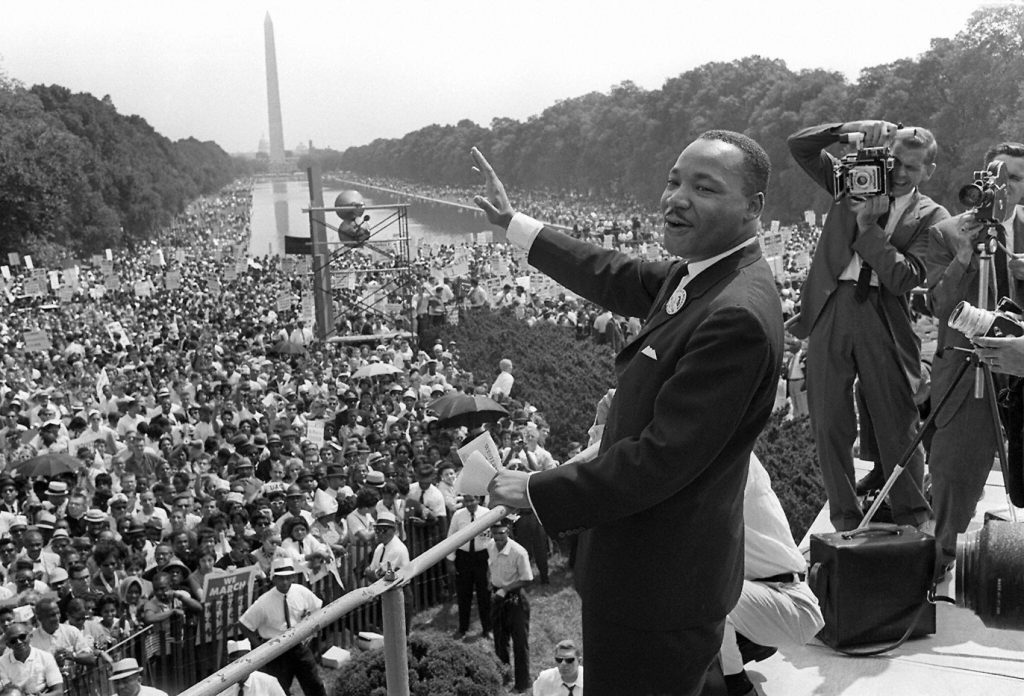
Alright. New Historicism. This is a literary theory that states that an Author’s work is heavily influenced by and reflects the movements of the time period of which it was written in. Now, Things Fall Apart was written in 1958, right in the middle of the Civil Rights Movement and towards the beginning of the decolonization of Africa. As today is MLK day, I figured this would be a fitting lens to use to see how the message of the book relates to the messages of key civil rights leaders.
Note: I will be referring to Martin Luther King’s teachings/ goals during the civil rights movement rather than Malcom X’s, as there were several conflicting ideas pertaining to how “equal rights” should be obtained and I’d like to focus on the more peaceful school of thought of the time.
Now, the primary aim of the Civil Rights Movement was to achieve equal rights between black and white Americans through social change. This principle of interracial equality is seen throughout Things Fall Apart through moments where the author indirectly points out the principle that “all people are people, regardless of anything else”. This principle could be seen in a conversation between Okonkwo and his friend, where it states, “‘During the last planting season a white man had appeared in their
clan.”An albino,’ suggested Okonkwo… ‘We have albinos among us.'” (Achebe 101). Here, Okonkwo points out that these white men are not as unfamiliar as the Igbo might have originally thought. People like the white men were already among them, suggesting that there is an inherent equality and familiarity between the white and black men, despite the vast cultural difference between the two.
In addition to this, the equality and similarities between the Ibo and the Christian settlers is also seen in a conversation with an Ibo and Mr. Brown, where they discuss that they both have a similar supreme god. ‘You say that there is one supreme God who made heaven and earth. We also believe in Him and call Him Chukwu’ (Achebe 179). Despite being raised in radically different worlds and cultures, the Ibo and the Christians have more common ground than they may care to admit, shattering the notion that either race’s culture in inherently superior to the other. It reinforces the idea that there is a common thread tying all humans together, which is a principle MLK advocated for in many of his speeches.
Now, the book’s messages and the messages of the Civil Rights Movement have more similarities than just supporting the idea that all humans are equal. Both movements also advocated for a policy of pacifism to deal with inter racial conflicts. In the book, the Igbo for the most part ignore the Christian settlers and refuse to drive them out for moral, social, and tactical reasons. However, the two times that the Ibo attempt to use violence, it only results poorly. When the Ibo burned the Christian’s church down, their leaders were tortured and they were required to pay a hefty ransom. When Okonkwo killed a Christian messenger, he had his final fall from grace and ended up killing himself. This struggle is very reminiscent of the Civil Right’s Movement, as the white “faction” had far more power than the black “faction”. The less powerful faction would be unable to use violence to fight injustices, as all it would lead to would be more violence and no resolution. Plus, as MLK once said “‘You can kill the dreamer, but you can’t kill the dream'”. No matter how many people you kill, an idea or culture goes beyond flesh. Violence would not solve these racial problems, be it in 1890s Africa or 1950s America.
 Dawn and Dusk
This was a really nice analysis and application of the New Historicism lens! Also, I always say this when I comment on your blog, but you always are so good at maintaining voice. It makes reading your blog way more interesting! Nice job, Daniel!
LikeLiked by 1 person
I’ve never thought about the role of pacifism within the Civil Rights Movement and “Things Fall Apart;” your analysis was super interesting and spot-on. You captivated my attention and I appreciate it. Awesome post!
LikeLiked by 1 person
I appreciate how you examine MLK’s work on a day in his honor, but based on the currency of Achebe’s time, what is his political message? Also, be sure to spell “Igbo,” as well as consistently embed all of your quotes!
LikeLike