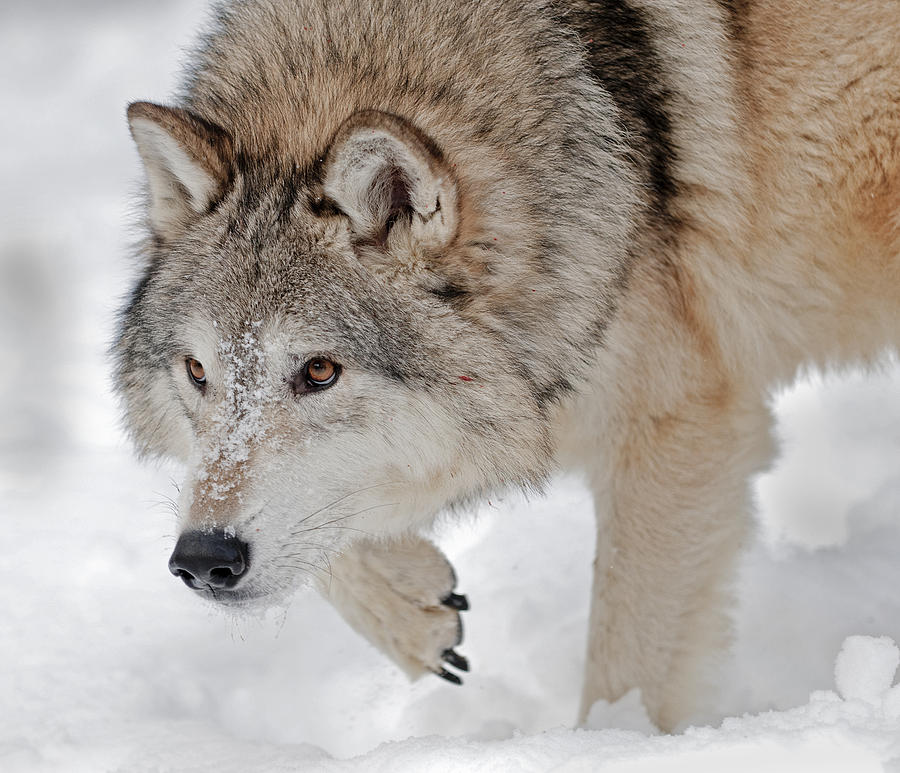
Dogs. They’ve been mentioned dozens of times so far throughout the book, and we have been told by the ” bookmark of guidance” that they are important. Quite frankly I’ve been trying to figure out what they symbolize for a while now, but in Chapter 10 two sentences led to me coming up with a hypothesis of one potential meaning…
“You are a dog in the manger Catherine!”
Isabella, Page 87
That got me thinking about dogs again. Hmm… well, perhaps dogs symbolize Catherine in some way? But why a dog? Well, dogs are merely wolves that have been domesticated and have joined human society, so therefore…
It was then when I read the following quote about Heathcliff:
“He’s not a rough diamond – a pearl containing an oyster of a rustic: he’s a fierce, pitiless, wolfish man.”
Catherine, Page 87
That’s when it hit me. Heathcliff is just like a wolf and Catherine is just like a dog. I know, it sounds slightly weird when I put it like that, but let’s go into why.
A wolf is often seen as a symbol of freedom and taking control of one’s own life, as they are powerful migratory animals. This trait is very evident in Heathcliff’s sudden departure from Wuthering Heights into god knows where, where he took initiative of his own life and made something of himself out there in the great unknown. However, wolves are also seen as wild creatures, widely feared and hated by humans. Heathcliff has been an outcast for his whole life, being anthropomorphize by being referred to as an “it” or as an animal frequently (notably, when Hindley called him a “cur”, which just means an unkempt dog). Just like a wolf, he is hated for how untamed he is and how his actions are often seen as “wild”. Plus, even Nelly’s early description of him resembles that of an unkempt wolf, with “thick brown curls” and “whiskers that encroached over his cheeks”. Furthermore, Heathcliff is a free willed and mischievous person, as seen when him and Catherine stalked the Lintons over nothing but entertainment. In fact while they were there, Heathcliff stated, “in the middle of the table sat a little dog, shaking its paw and yelping… we laughed outright at the petted things; we did despise them!”. This reveals how Catherine and Heathcliff value freedom above all else, and despise the domesticated little dogs that simply live out their days being pampered while having no freedom. In short, Heathcliff and Catherine love feeling free and untamed (like wolves) and despise the tamed complacency of the yelping little dog. After all, “their souls are made of the same material”, as at their core they are both freedom loving wild animals.
However, even the mightiest of wolves can be turned into dogs through enough human intervention. Such was the case with the once free-spirited Catherine. Before staying at the Lintons, Catherine was a “wild, wicked slip” who would “sing laugh and plague anybody who would not do the same”. Her father despised her for being un-lady like and careless. However, during her stay with the well refined Lintons, all of this changed. She returned “a very dignified person”, and was so different upon her return that Heathcliff “Thought her converted into an stranger by her grand dress”. She lost the wildness in her, and never messed around with Heathcliff like she used to, instead opting to have indoor tea parties with Edgar Linton. In short, she had been domesticated, turning from a wolf into a dog (metaphorically, of course). Catherine’s interactions with dogs also support this idea, as it was a dog that chanced down Cathy, bit her foot (*cough* *cough* feet are an archetype for freedom, the dog representing refined society took away her freedom *cough*) which caused her to stay at the Lintons and become “tamed”. Plus, when she returned to Wuthering Heights after her stay at the Lintons, dogs greeted her cheerily at the gate, almost seeming to welcome her into the fold.
Alright, alright, that’s a lot of words, but I still haven’t truly defined what the dogs represent in the story! For those of you skimming over the paragraphs above, it all boils down to this: dogs are nothing but a tamed wild animal. Catherine was once described as “wild” but after her stay at the Lintons she was “tamed” and became part of refined society. As a whole, the dogs are a symbol of Catherine as well as a symbol for “refined” society, which fits in quite well with the whole theme on the differences of social classes. Dogs, at some point in their ancestral lineage, were wild animals, and are remarkably similar to wolves in everything but behavior. Just like how every rich family, at some point in their ancestral lineage, were not too wealthy, and are human just like the lower classes only they act differently.
Also, for those who aren’t sold on the whole “wolf” metaphor because Heathcliff was only referred to as “wolfish” once, just replace the words “wolf” with a wild animal in your mind and it all fits rather nicely. The symbolism and traits of “wild animals” line up almost identically with wolves anyway: freedom loving, but hated and feared by humans. I compared him to a wolf because that is the origin of dogs, and there is a lot of imagery that sound wolf like (like at the end of chapter 10 when Nelly said Heathcliff acted like he was stalking stray sheep) but at the end of the day dogs are just a poster child of domesticated animals so the whole “dog symbolism” argument should still hold true no matter what animal Heathcliff most resembles.
Cheers!
 Dawn and Dusk
I love how you call the bookmark “the bookmark of guidance.” It’s like the magic conch in Spongebob!
I thought your analysis was well thought out and I was hoping someone would talk about it! All of the evidence and insightful commentary made sense and my mind blew up a couple times.
However, I was expecting their to be Onomatopoeia of barking, but the intelligent blog post made up for it.🐶
LikeLike
WOW! YES, DANIEL! What an impressive and well-supported analysis of the role of dogs thus far in the novel. It would be fascinating to apply your theory to what happens to the dog in Chapter 12 if we consider Heathcliff and Isabella’s relationship. Really incredible work. I also love how you bring in the archetypes and reference the “Bookmark of Guidance.” It does the beg the question, what was the purpose of that gray cat in Chapter 3?
LikeLike
This was such an epic and insightful post. You highlighted a point that I totally overlooked. I think it’s fascinating that while Catherine used to be like a wolf so to speak, her experience with wealth and luxury “domesticated” her. Great job!
LikeLike
I am just dumbfounded by this symbolism! I was always confused about the meaning of the dogs in the story, but your description and discovery is really mind-blowing and fantastical. I would have never thought about this before. Excellent discovery!
LikeLike
Dang Daniel, back at again with the amazing analysis! Besides the obviously thorough and well-supported arguments you made, the voice that shone through your writing, even in basic analytical writing, really amazing me and made this so much fun to read. I agree with Veronica, and would add that we need a dramatic reading of this in class complete with barking noises…
LikeLike
*was really amazing to me
LikeLike
As many others have mentioned, this post is phenomenal! You did a wonderful job highlighting the symbolism of dogs within the book and you made it interesting and fun to read! Nice job, Daniel!
LikeLike